
Preface
NOTE: This chapter is not complete. We expect to have it finished in 2025. This will then connect to further related studies.
This ending of Revelation reconnects elements found in Genesis, which ‘disappear’ through the rest of the Tenach, to the Olam Haba. It unifies concepts discussed in the writings of Zohar, the Bahir and many great sages and rabbis of Israel.
1 And he showed me a pure river of water of life, clear as crystal proceeding from the throne of G-d and of the Lamb.
The river of life returns, having been absent in the Tenach since chapter 2 of Genesis.
And a river flowed out of Eden to water the garden, and from there it separated and became four heads. The name of one is Pishon; that is the one that encompasses all the land of Havilah, where there is gold. And the gold of that land is good; there is the crystal and the onyx stone. And the name of the second river is Gihon; that is the one that encompasses all the land of Cush. And the name of the third river is Tigris; that is the one that flows to the east of Assyria, and the fourth river that is the Euphrates.
Genesis 2:10-14
These four ‘heads’ of the river, are associated with the four-letter name of G-d, four worlds of existence, etc. (See the “soul chart” at http://www.13petals.org/soulchart.) The reappearance of the river reflects the (re)unified state of the Olam Haba, similar to Gan Edan before the sin of Adam.
The doctrine of the four elements is an integral part of traditional rabbinic thought, and is found both in classic Jewish philosophy and in the Kabbalah (see Mishneh Torah, Hilkhot Yesodey HaTorah chapters 3 & 4, Shaarey Kedushah III:1-2, Etz Chaim, Shaar Kitzur ABYA 10, etc.). It is rooted in the Bible, which tells us that “a river comes out of Eden to water the garden, and from there it divides and becomes four heads” (Genesis 2:10). The “river” alludes to the unitary creative power of God, which contains in potential all the multifarious powers that are manifest in the actual creation. Just as a single beam of white light can be refracted to reveal its constituent colors, similarly the unitary power of God is “refracted,” as it were, in the finite creation, dividing into four “heads,” alluded to in the four letters of the Tetragrammaton, Yud Heh Vav Heh. These four “heads” are the four elements of fire, air, water and earth (Likutey Moharan II, 67). It is most important to grasp that the use of the word “elements” here has nothing to do with its use in modern chemistry to refer to the various physical substances of which all natural phenomena are composed. In chemistry, the “elements” are those substances that cannot be resolved by chemical means into simpler substances. The “four elements” of Torah thought, on the other hand, which in Hebrew are called יסודות (yesodot), “foundations,” are not necessarily physical at all, and they are certainly not to be simply identified with physical fire, air, water and earth as we know them.
The Winds of the Sun, chapter 12 Rabbi Avraham Greenbaum
https://www.azamra.org/Heal/Wings/12.htm
Psalm 46, through which the end of this age is alluded to, makes a direct connection between a river and the “city of G-d” – flowing from Jerusalem above to Jerusalem below:
There is a river, the streams of which make the city of G-d glad, the holy place of the tents of the Most High.
Psalm 46:4
The Zohar cites this verse and adds reference to Jeremiah:
“Then the verse proceeds: “Who layeth the beams of his chambers in the waters”: here we have the emergence in joy of the Tree of Life, the “River going out of Eden”, with the two willow shoots, referred to in the words “upper chambers”, rooted in its waters, so that it became “as a tree planted by the waters, that spreadeth out her roots by the river” (Jerermiah 17:8). This is also the allusion contained in the words: “The river, the channels thereof shall make glad the city of God” (Psalm 46:4).
Zohar 2:98b
The return of this river is associated with the “Day of the Lord” and viewed in terms of a thousand-year period of time:
The Day of the Holy One, blessed be He, is a thousand years, and this number symbolizes also the River which goes out of Eden.
Zohar 2:145b
The completeness of the unification of the Name YHVH is linked to the return of the “River of Eden. This is spoken of in Zechariah 14:9 and symbolized by the uninterrupted connection between the first letter Yud and the last letter Hey:
“When the Yod is united with the Hey, they produce “the river which issues from Eden to water the Garden.”
Zohar 1:95b
The term for the ” flow of spiritual power and energy” provided by this river is called “Shefa.” In his introduction to Rabbi Moshe Chaim Luzzatto’s book on the third Temple, Mishkney Elyon (Dwellings of the Supreme), Rabbi Avraham Greenbaum explains “Shefa” as follows:
In Mishkney Elyon and Kabbalah generally, Shefa refers to the spiritual influences which emanate from the higher levels of creation in order to sustain the lower and help bring them to their destiny. The word “creation” here refers to all the different “worlds” and levels brought into being by God. These created worlds encompass not only this material World of Asiyah (Action) in which we live, including the Earth and all it contains, and all the planets, stars and galaxies to the outer limits of the physical universe but also the spiritual worlds that exist in the metaspace that is “above” our World of Asiyah. These are the World of Yetzirah (Formation), world of the angelic hosts that sustain and govern the stars, planets and other natural phenomena of Asiyah, and the World of Beriyah (Creation), world of the higher angels, the “officers” that govern the angelic hosts of Yetzirah. The World of Beriyah is also known as the “World of the Throne”. Beyond Beriyah lies a realm of Godly unity that is the source of all these created worlds: this realm of unity is the World of Atzilut (Emanation), from which the light of the Ten Sefirot shines forth to create, sustain and govern all the lower worlds. Creation is not only a single past act. It is also a continuing process in which all the worlds are governed in such a way as to bring all things to the ultimate goal, the complete revelation of God on all levels of creation. To accomplish this goal, there is a continuous influx of various kinds of “power” or “energy” into creation. These “powers” sustain and govern all the different levels of creation, spiritual and physical, so as to bring all things to the ultimate goal. This flow of power and energy is called Shefa.The ultimate goal of creation is the end point to which everything is moving. The reason why everything is “going” in that direction is because that is where God is making everything go. To make something go is to drive it, as when one drives an animal or car. The Hebrew word for “driving” is Hanhagah, from the root Nahag, which means to drive or make something go. The kabbalistic concept of Hanhagah refers to the way the worlds are actually governed in order to bring everything to the ultimate goal of creation. Creation is seen as being “driven” by God, somewhat as a chariot (Merkavah) and the animals pulling it are driven by the charioteer. The “animals” of the divine “Chariot” are the Chayot, the higher angels that are the vital forces of creation. As the Chayot “draw” the Chariot, the Ofanim (literally “wheels”) go round and round: these are the lower angels that govern the great wheels or cycles of creation. The Hanhagah or “driving” is ultimately determined by the One sitting “in the driver’s seat”, this being the Throne of Kingship. From it the King governs all His “armies” or “legions” – the souls, angels and other orders and levels of created beings. All these “hosts” are God’s “armies” sent to accomplish His purpose, and He sustains them and provides all their needs according to their different levels, spiritual and physical.
Secrets of the Future Temple (Mishkney Elyon), Rabbi Moshe Chaim Luzzato, translated by Avraham Greenbaum, p.28-30.
This connection between the letter Yud and the final letter Hey (in YHVH) and the River of Eden is also spoken of in terms of “Upper Wisdom” and “Lower Wisdom.” This explains why Wisdom is referred to in a feminine context in places such as the book of Proverbs. The axiom is, “When the daughter is connected to the father, she is called Wisdom”
WISDOM CRIETH ALOUD IN THE STREET, SHE UTTERETH HER VOICE IN THE BROAD PLACES (Proverbs 1:20). ‘This verse’, he said, ‘contains a deep mystical teaching. The term hokhmoth (lit. wisdoms) implies the superior Wisdom and the lesser Wisdom which is included in the superior Wisdom and abides therein. The superior Wisdom is an essence most recondite and concealed, unknown and unrevealed, as Scripture says: “Man knoweth not the price thereof, etc.” (Job 28:13); and when it expands into a source of light, its illumination is that of the world to come, and that world is created by it: for so we have learned, that the world to come was created by the Yod, and there Wisdom remained hidden, the two being one. When God was crowned, it was through the mystery of the future world, as already said. There was joy at this illumination, but all was in silence without a sound being heard abroad. Wisdom then willed it to expand further, so that from that space there issued fire and water and air, as already said, from which there sprang up a voice which issued forth abroad and was heard, as already said. From that point onwards all is exterior (huz), whereas in the interior the voice is silent and not heard abroad. Once, however, the secret force has become audible, it is called “without” (huz). Hence it is incumbent on man to be zealous in searching after wisdom “in the wide places” (ba-rehoboth). This refers to the firmament, which contains all the luminous stars, and which constitutes the fountain of perennial waters, referred to in the verse: “And a river went forth from Eden to water the garden” (Genesis 2:10). And there “she uttereth her voice”, both the superior and the lower Wisdom, which in truth are one.
Zohar 1:141b
Author Aryeh Kaplan states the following in his book, “Waters of Eden”:
Water is the primary connection we have with the Garden of Eden … Even though a person cannot reenter the Garden of Eden itself, whenever he associates himself with these rivers – or with any other water – he is reestablishing this link with Eden
Waters of Eden, Aryeh Kaplan, 1976, p.35
Rivers, water and wells are all associated with the idea of Wisdom. Thus we see numerous mentions of wells in Scripture. The Zohar further connects wisdom and water with the idea of resurrection and the world to come.
AND ISAAC DIGGED AGAIN THE WELLS, ETC . R. Eleazar said: ‘In digging these wells Isaac acted fittingly, for he discerned from his knowledge of the mysteries of Wisdom that in this way he could attach himself more firmly to his faith. Abraham likewise made a point of digging a well of water. Jacob found the well already prepared for him, and he sat down by it. Thus they all looked for a well and strove through it to preserve their faith pure and undiminished. …Hence our ancestors strengthened themselves in the true faith in digging the well, symbolic of the supernal well, which is the abode of the mystery of perfect faith.’ AND HE REMOVED FROM THENCE, AND DIGGED ANOTHER WELL. R. Hiya discoursed on the verse: And the Lord will guide thee continually, and satisfy thy soul in brightness, and make strong thy bones (Isaiah 58:11). ‘The true believers’, he said, ‘have derived strength from this verse, where promise is made to them of the world to come, for the word “continually” includes both this world and the world to come. Again, the term “continually”, which seems superfluous, is an allusion to the continual burnt-offering which is offered at dusk, and is held firm underneath the arm of Isaac and is symbolic of the world to come. The term “guiding” is similarly used by David in the verse: “He guideth me in straight paths for his name’s sake” (Psalm 23:3). “And satisfy thy soul in brightness”; this is the “clear mirror” from the contemplation of which all souls obtain delight and benefit. “And make strong thy bones”: these words do not seem to harmonise with what has gone before, which we have interpreted of the souls of the righteous ascending on high. We interpret them, therefore, to allude to the resurrection of the dead, when the Holy One, blessed be He, will reconstitute the bones and restore the body to its former state. The soul will then derive stronger illumination from the “clear mirror”, so as to illumine the body to the full extent of which it is capable. Hence: “And thou shalt be like a watered garden” (Isaiah 58:11), that is, like the celestial garden whose supernal waters never fail, but flow on for ever and ever; “and like a spring of water, whose waters fail not” (Ibid.), alluding to the river that issues from Eden and flows on for all eternity. Observe that the “well of living waters” is a symbol within a symbol for guiding faith. There is the well which is the very source of the waters, and there is the well which is fed by that source of water. There are thus two grades, which are, however, really one with two aspects, male and female, in fitting union. The well and the issue of waters are one, designated by the name of “well”, it being at once the supernal never-ceasing fountain and the well that is filled by it. And whoever gazes at that well gazes at the true object of faith. This is the symbol which the patriarchs transmitted in digging the well, in such a way as to indicate that the source and the well are indissoluble.
Zohar 1:141a
2 In the middle of its street, and on either side of the river, was the tree of life, which bore twelve fruits, each yielding its fruit each month. The leaves of the tree were for the healing of the nations.
This mystical “Tree of Life” was last mentioned in a warning. We see an aspect of ‘eternity’ associated with it:
Then the Lord G-d said, “Behold, the man has become like one of us in knowing good and evil. Now, lest he reach out his hand and take also of the tree of life and eat, and live forever.
Genesis 3:22
The text aligns with what we find in Ezekiel’s vision:
“Now when I had returned, behold, on the bank of the river were very many trees on the one side and on the other. Then he said to me, These waters issue forth toward the eastern region, and shall go down into the Arabah, and they shall go toward the sea, into the sea shall the waters go which were made to issue forth; and the waters shall be healed.”
Ezekiel 47:7-8
“By the river on its bank, on this side and on that side, shall grow every tree for food, whose leaf shall not wither, neither shall its fruit fail: it shall bring forth new fruit every month, because its waters issue out of the sanctuary; and its fruit shall be for food, and its leaf for healing.”
Ezekiel 47:12
The benefit of this tree is found in other sources as well:
“I am the One who planted this tree in order that all the world should delight in it. And in it, I spread All. I called it All because all depend upon it, all emanate from it, and all need it. To it they look, for it they wait, and from it, souls fly in joy.”
Bahir 22
“What is this tree that you mentioned? He said: It represents the Powers of the Blessed Holy One, one above the other.”
Bahir 119
The following passage of the Zohar further connects Wisdom, the River of Eden and the Tree of Life, whose fruit brings everlasting life:
It is written: And the wise shall be resplendent as the splendour (zohar) of the firmament, and they that turn many to righteousness shall be like the stars for ever and ever (Daniel 12:3). “The wise” are those who penetrate to the real essence of wisdom; “they shall be resplendent”, i.e. illumined with the radiance of the supernal Wisdom; “as the splendour”, this is the flashing of the Stream that goes forth from Eden (Genesis 11:10), this being alluded to as “the firmament”. There are suspended the stars, the planets, the sun and the moon, and all the radiant lights. The brightness of this firmament shines upon the Garden of Eden, and in the midst of the Garden stands the Tree of Life, whose branches spread over all forms and trees and spices in fitting vessels. All the beasts of the field and all the fowls of the air shelter beneath the branches of this Tree. The fruit of the Tree gives life to all. It is everlasting. The “other side” has no abode therein, but only the side of holiness. Blessed are they who taste thereof; they will live for ever and ever, and it is they who are called “the wise”, and they are vouchsafed life in this world as well as in the world to come. The Tree rises to a height of five hundred parasangs, and its circumference is six myriads of parasangs. Within this Tree is a light [Tr. note: Tiferet] out of which radiate certain colours: they come and go, never being at rest save in the Tree.
Zohar 2:2a
The Zohar goes on to associate the River with the letter vav and the “central column” (another reference to the role of Metatron, as mentioned in earlier studies). The Tree of Life has dominion over the Tree of Knowledge of Good and Evil, which is aligned to the power of the mixed multitude:
AND THE LORD GOD CAUSED TO GROW. The two names may be referred to the Father and the Mother; “every pleasant tree” refers to the Zaddik; “good to eat” refers to the Central Column, through which He provided food for all, and from which alone the Zaddik is nourished, as the Shekinah from him. These have no need of the lower world, but, on the contrary, all below are nourished from him. For in this period of captivity the Shekinah and “the Life of the universe” are only nourished by the eighteen blessings of Israel’s prayer, but at the time he will be food for all. AND THE TREE OF LIFE. This means that at that time the Tree of Life will be planted in the Garden, so that “he shall take also of the Tree of Life and eat and live for ever” (Genesis 3:22). The Shekinah will no longer be in the power of the “evil influence”, i.e. the mixed multitude who are “the tree of the knowledge of good and evil”, and shall no longer receive into itself anyone unclean, to fulfill what is written, “the Lord alone shall lead him and there shall be no strange god with him” (Deuteronomy 32:12). For this reason proselytes will no longer be admitted in the days of the Messiah. The Shekinah will be like a vine on which there cannot be grafted any shoot from another species, and Israel shall be “every tree pleasant to see”, and their former beauty shall be restored to them, of which we are told: “He cast from heaven to earth the beauty of Israel” (Lamentations 2:1). “The tree of the knowledge of good and evil” shall be thrust from them and shall not cleave to them or mingle with them, for of Israel it is said: “and of the tree of the knowledge of good and evil ye shall not eat”. This tree is the “mixed multitude”, and God pointed out to them that through mixing with them they suffered two losses, of the first and of the second Temple, as it is said: “and on the day that thou eatest of it thou shalt surely die”. They caused the Zaddik to be left parched and desolate by the loss of the first Temple, which is the Shekinah in heaven, and by the loss of the second Temple, which is the Shekinah on earth. Hence it is written, “and the river shall be drained dry”; i.e. the river vau shall dry in the lower he, so as to deprive it of the flow of yod issuing from En-Sof. But as soon as Israel shall go forth from captivity, that is, the holy people alone, then that river which was dried up shall become “the river that goes forth from Eden to water the garden”. This river is the Central Column; “goes forth from Eden” is the supernal Mother; “to water the garden” is the Shekinah on earth. In reference to that time it is said of Moses and Israel, “Then thou shalt delight in the Lord”, and the words shall be fulfilled, “then Moses shall sing” (Exodus 15:1) … … Further, the river shall part from thence and become four heads (Gen. II, 10). The first of these is Hesed (Kindness), which is the right arm. From this shall drink the camp of Michael, and with it the tribe of Judah and his two accompanying tribes. The second is Geburah (Force), and from it shall drink the camp of Gabriel, and with it the tribe of Dan and his two accompanying tribes. The third is Nezah (Victory), the right leg, and from it shall drink the camp of Nuriel, and with it the tribe of Reuben and his two accompanying tribes. The fourth is Hod (Majesty), the left leg (referred to in what was said of Jacob, that he halted on his left thigh), and from it shall drink the camp of Raphael, whose mission is to heal the ills of the captivity, and with it the tribe of Ephraim and his two accompanying tribes.
Zohar 1:26a,b
The Tree of Life is once again made accessible to human beings. Originally, this tree was not prohibited to Adam. Only after the sin with the Tree of Knowledge of Good and Evil did the Tree of Life become prohibited. This sin is compared to removing the bride from the groom (or the Sefirah of Malkut from the rest of the Sefirot) thus causing a “separation” in the Name of God. Access to the Tree of Life only comes through the Tree of Knowledge of Good and Evil which is rectified only when the name of God is made “one” again with the final “hey” (Malkut, the Tree of Knowledge of Good and Evil) reunited to the Tree of Life (see verse 1 notes above).
Sha’are Orah (Gates of Light) Rabbi Joseph Gikatilla, 219-220
The reference to twelve fruits and leaves healing the nations shows the relationship of the Tree of Life to Israel and Israel’s to the nations. The latter is often expressed in terms of the numbers twelve and seventy and related to the wells and palm trees in Elim from Exodus 15:27.
Just as there were twelve and seventy below at Elim, there are twelve and seventy in the spiritual worlds as one is patterned on the other:
It has been said at that hour Israel was perfected below according to her prototype above, for it is written, “and they came to Elim, where were twelve wells of water and threescore and ten palm trees” (Exodus 15:27). Now the Holy Tree [Tr. note: Tiferet] spreads to twelve boundaries on the four quarters of the earth, and to seventy branches closely intertwined, so that what was above should have here its counterpart below.
Zohar 2:62b
The twelve wells/fruits (Israel) provide for all the nations.
Blessed are the Israelites who “sow beside the water”-the water which is under the branches of the Holy One’s Tree, a Tree great and mighty, containing food for the whole universe. This Tree is encompassed by twelve frontiers and adjoins all four sides of the world, and has seventy branches, and Israel is in the “body” of the Tree, and the seventy branches encompass her. This is symbolized by the “twelve wells of water and the threescore and ten palm trees”, as we have often explained.
Zohar 2:64b
The following texts mirrors the end of verse 2 (above) closely:
‘There is a mighty and wondrous tree in the celestial sphere which supplies nourishment to beings above and below. It has twelve boundaries and stretches along the four sides of the world which encompass it. Seventy branches ascend from it and imbibe nourishment from its roots. Each branch, as the time arrives for it to be dominant, endeavours to drain the whole life of the tree, which is the essence of all the branches, and without which they would not exist. Israel clings to the main body of the tree, and when its time comes to be dominant, it endeavours to protect the branches and to give peace to all. This is also symbolized by the seventy oxen offered on the feast of Tabernacles. Therefore it says: “Who is like unto thee among the gods (elim), O Lord?”; elim in the sense of “trees”, as in the passage, “for ye shall be ashamed of the elim (terebinths) which ye desired” (Isaiah 1:29). “Who among these is like unto Thee, Who hast pity on all? Among the surroundings of the tree is any like unto Thee, eager to be the guardian of all, even when it dominates them”, not wishing to destroy them? “Who is like unto Thee, glorified in holiness?” Namely, in that supreme power called “Holiness”, “power of the Lord”, “pleasantness of the Lord”, as already stated.’
Zohar 2:58b-59a
The concept of a ‘cube’ was alluded to in the previous chapter
“The Blessed Holy One has a single Tree, and it has twelve diagonal boundaries. The northeast boundary, the southeast boundary, the upper east boundary, the lower east boundary, the southwest boundary, the northwest boundary, the upper west boundary, the lower west boundary, the upper south boundary, the lower south boundary, the upper north boundary, the lower north boundary. On the inside of them is the Tree.”
Bahir 95
All of the Torah which we learn in Olam Ha’zeh is like nothing compared to the Torah in Olam Haba, since in Olam Ha’zeh a person can learn Torah and forget it.
Kohelet Rabba 2:1
In Olam Ha’zeh, death does not allow man to have [complete] simcha, but in Olam Haba, death will be banished.
Tanchuma — Vayechi 3
Olam Ha’zeh has wars and difficulties. And the yeitzer hara (negative inclination) along with the Malach HaMavet (Angel of Death) have the ability to control the world. But in Olam Haba, there will be no difficulties, no suffering, and no subjugation.
Medrash V’Yosheah 22
3 And there shall be no more curse, but the throne of G-d and of the Lamb shall be in it, and His servants shall serve Him.
In Olam Ha’zeh, we make the blessing HaTov v’HaMeitiv (the One Who is good and does good) on good news, and we say Dayan HaEmet (the True Judge) on bad news; but in Olam Haba — we will only say HaTov v’HaMeitiv.
Gemara Pesachim 50a
In Olam Ha’zeh, it is impossible to see everything that happens to us as truly for our good. Even one on the level of Moshe Rabeinu would need to say the blessing of Dayan HaEmet on what he feels is negative from the perspective of Olam Ha’zeh. However, in Olam Haba, we will clearly see that all of the ways of Hashem are intrinsically good. That is why we will make the blessing of HaTov v’HaMeitiv on everything… Those concepts that we know today with our minds, will be [fully] revealed to us in Olam Haba. Michtav M’Eliyahu – Ikar hagilui sh’b’Olam Haba 3:279
The return to Eden reverses the effects of the Tree of Knowledge of Good and Evil.
Regarding the idea of the Lamb in the throne, refer to the section “The Divine Jacob” in our notes to chapter 14, where we highlight the idea in multiple Jewish sources of Jacob (the primary messianic figure in the Torah) being in, on or under the heavenly throne. A compilation of citations on this idea is found in Elliot Wolfson’s book, Along the Path: Studies in Kabbalistic Myth, Symbolism, and Hermeneutics:
- Numbers Rabbah 4:1:
There is a Scriptural text bearing on this: Since thou art precious in My sight, and honourable, etc. (Isaiah 43:4). The Holy One, blessed be He, said to Jacob: Jacob, thou art exceedingly precious in my sight. For I have, as it were, set thine image on My throne, and by thy name the angels praise Me and say: Blessed be the Lord, the God of Israel, from everlasting and to everlasting (Psalm 41:14).
- From Midrash Yelammedenu:
The angels descended and saw his (Jacob’s) image. They said, “Certainly this is the form (surah) and this is the image (demut) engraved upon the throne of glory.” All of them responded and said, “Bless the Lord, God of Israel.”
- From a liturgical poem of Moses ben Eleazar ha-Darshan:
… the Biblical expression “majesty of Israel” (from Lamentations 2:1) is transformed into a symbol for the icon of Jacob engraved on the throne.
4 They shall see His face, and His name shall be on their foreheads.
For now we see in a mirror dimly, but then face to face. Now I know in part; then I shall know fully, even as I have been fully known.
1st Corinthans 13:12
There is a tradition that says when Moses asked to see the ‘face’ of G-d but was only shown the ‘back,’ it relates to him receiving the mystical insights that only deal with issues in our present reality – the Olam Hazeh. That which lies “outside of the bookends” (before Creation and into the Olam Haba) is the ‘face,’ and was not revealed.
The curse (verse 3) from Eden results in “the Face” of G-d being hidden. Its removal results in a new level of relationship between G-d and man. In Parsha Mishpatim, not only do Moses and others see G-d and live, they end up enjoying a meal in G-d’s presence! This would seem to be a foreshadowing of the great banquet destined to occur at the time of the Olam Haba.
In the Future to Come, the Holy One blessed be He, will make a banquet for the pious in the Garden of Eden. Rabbi Elazar said, “The banquet of the righteous in the Future to Come will be as it is written, ‘And they beheld G-d and did eat and drink’ (Exodus 24:11).”
Mid. haNe’elam, Zohar 1:135b, as cited in The Messiah Texts p. 244.
5 There shall be no night there: They need no lamp nor light of the sun, for the Lord G-d gives them light. And they shall reign forever and ever.
On that day there will be neither sunlight nor cold, frosty darkness. It will be a unique day—a day known only to the Lord—with no distinction between day and night. When evening comes, there will be light.
Zechariah 14:6,7
There is no Gehenom (eternal punishment) in the world to come, rather Hashem will bring out the sun from its container; tzadikim (the righteous) will be healed through it, and reshayim (the wicked) will be judged through it.
Reish Lakish, Nedarim 8b
Another aspect of “division” comes to an end.
“The sun shall be no more your light by day; neither for brightness shall the moon give light to you: but the LORD will be to you an everlasting light, and your G-d your glory.”
Isaiah 60:19
The aforementioned “banquet” is the time of great light throughout the world:
In the Future to Come, the Holy One blessed be He, will bring the pious to the Garden of Eden … the Holy One blessed be He hearkens unto them and enters with them into the Garden of Eden. And as soon as the Holy One blessed be He comes there, the pious stand up on their feet, and the whole world becomes filled with light … He says to them, “My sons, since the day that I created the world, I never withheld anything from you except my Throne of Glory … but now I give you a share even in my Throne of Glory.
S’udat Livyatan BhM6:150-51, as cited in The Messiah Texts p. 240.
There is a connection between the “Face” of G=d in verse 4 and the light mentioned here in verse 5 and the state of total mercy expressed in verses 1-3 beforehand:
Whenever you see the words “light” and “face” in the Torah (i.e., Proverbs 16:15), their essence is contained above where the gates of the realm of great mercy are opened and all the Spheres are full of mercy and life, and all the worlds are filled with compassion and mercy and no prosecutor has the power to harm any creature through harsh judgment or punishment at all.
Sha’are Orah (Gates of Light) Rabbi Joseph Gikatilla, p. 353, 354.
Humanity enters a new and miraculous time:
In the Era of the Redemption, even the miracles which are enclothed in the natural order will be revealed. That is, mankind will be able to perceive these miracles. In addition, this will indicate a higher level of the miracles themselves. At present, the natural order conceals the miracles because the natural order represents the very opposite of the miraculous [even when a miracle is enclothed with it]. This is because a miracle represents a deviation from the natural order, a change from its ordinary functioning. Therefore [in the present era, the uniqueness of] the miracles which transcend the natural order is more apparent. In the Era of the Redemption, however, the miracles which are enclothed within the natural order will also be revealed, as it is said, “I will show you wonders”. The reason for this difference is that in the Era of the Redemption, the natural order will be elevated, and it will also be a suitable medium for the revelation of the infinite dimensions of the light of the Ein Sof which will be enclothed within it. Therefore, the miracles which are enclothed in nature will also be overtly revealed.Thus the new dimension implied by the prophecy “I will show you wonders” – that the wonders will be perceived – will be reflected in the wonders themselves. At present, the miracles enclothed in nature are such that even after the revelation of the infinite dimensions of the light of the Ein Sof through the miracle, the existence of the natural order remains unaffected. In addition, its thrust is directly opposite to the revelation of infinite light (except that the revelation of the infinite light controls it and compels its course to follow the dictates of G-d’s will). In the Era of the Redemption, by contrast, the miracles that are enclothed within the natural order will possess both advantages: 1) the revelation of light of the Ein Sof will be expressed within the natural order; and 2) there will be no entity whose existence runs contrary to the revelation of [G-d’s] infinity, for even nature will be a medium [for the expression of] the infinite dimension of light of the Ein Sof.
https://www.chabad.org/kabbalah/article_cdo/aid/380380/jewish/Perceiving-Miracles.htm
6 Then he said to me, “These words are faithful and true.” And the Lord G-d of the holy prophets sent His angel to show His servants the things which must shortly take place.
Another dimension of the Olam Haba ‘resembling’ Gan Edan is seen here in verses 5 and 6. which make use of the ‘combined’ name, “Hashem-Elohim” (Lord G-d) which is used throughout the narrative of the Gan Edan story from Genesis 2:7 through 3:23.
7 “Behold, I am coming quickly! Blessed is he who keeps the words of the prophecy of this book.”
8 Now I, John, saw and heard these things. And when I heard and saw, I fell down to worship before the feet of the angel who showed me these things.
9 Then he said to me, “See that you do not do that. For I am your fellow servant, and of your brethren the prophets, and of those who keep the words of this book. Worship G-d.”
This angel is similar to that mentioned in 19:10 in that it is associated with prophecy in this verse and with messiah in verse 16. Verse 9 adds a peculiar dimension as the angel identifies himself as being of one of John’s “brethren the prophets,” seemingly identifying himself as human and of the Jews. The text presents a clouding of the distinction between the spiritual and physical – not atypical of Hebraic mystical literature, such as 3Enoch where Enoch is transformed into the angel Metatron, who occupies a throne next to the throne of G-d. As in verse 19:10, here is an angel with a presence in John’s vision so strong it inspires a reaction to fall in worship.
Author Elliot Wolfson provides several insights that relate to this, again mentioning the idea of the “blurring of the distinction” between G-d and Metatron in the prophetic vision, often in terms of the Shekinah, and how G-d can be referred to in many ways, citing the specific example of the burning bush:
It may be said that the medieval Jewish mystics recovered the mythic dimension of a biblical motif regarding the appearance of God in the guise of the highest of angels, called “angel of the Lord” (mal’akh YHVH), “angel of God” (mal’akh ha-Elohim), or “angel of the Presence” (mal’akh ha-panim), which sometimes appears in the form of a man. … This tradition of angelophony figured prominently as well in the literature of both the German Pietists and the Provencal-Spanish kabbalists. In both cases we find evidence for the identification of, or the blurring of the distinction between, the glory and an angelic being, the anthropomorphic manifestation of the divine revealed to the prophets and mystics. More specifically, in some of the earliest kabbalistic sources the Shekinah is identified in one of her aspects as Metatron …In some literary units of the Hekhalot literature, it is very difficult, if not impossible, to differentiate between G-d and his angel. The attribution of divine characteristics to the highest angel also underlies traditions about Metatron, the demiurgical angel in ancient Jewish esotericism. The confusion is especially evident with respect to the name of G-d and Metatron. 4The verse said, “I am sending an angel before you” (Exodus 23:20). This refers to the Shekinah, for the word mal’akhi (“My angel”) … has a numerical value of Shekinah (=385).
Thus it is established in the secret of the Chariot (sod ha-merkavah) that the Holy One blessed be He, is mentioned as an angel in the secrets of the angels, (a sphere) in the secret of the spheres, and that is the throne. All of these are emanations that emanate from the splendor of His great infathomable and limitless light. Thus it is written in Exodus (3:2), “An angel of the Lord appeared to him in a blazing fire out of a bush,” and immediately after it is written, “G-d called to him out of a bush,” and it is written, “for he was afraid to look at G-d. Therefore the word mal’akh (angel) numerically equals ha-‘elohim (the divine).
Through a Speculum That Shines: Vision and Imagination in Medieval Jewish Mysticism, Elliot R. Wolfson, p.257
Wolfson cites an ancient text in pointing out the relationship in the gemmatria (314) between not only Metatron and the G-d-name Shaddai (as is well known and mentioned earlier in this study), but also to a phrase often associated with G-d Himself:
The Prince of the Countenance is called Metatron, he is all-powerful (ha-kol yakhol). Thus the numerical value of Metatron (=314) is equal to the expression ‘he who governs the whole world; (ha-manhig kol ha-olam = 314). This is the numerical value of Shaddai (=314)
Through a Speculum That Shines: Vision and Imagination in Medieval Jewish Mysticism, Elliot R. Wolfson, p.259
Further, we know that “he who governs the whole world,” does so from the Heavenly Throne. The following citations show relationships between multiple entities in the spiritual worlds:
We begin with the unity between the four creatures of the Ezekiel’s chariot:
“The principal form of the four creatures, which collectively comprise one entity, is that of an anthropos (a man), also identified as the cherub …
Along the Path: Studies in Kabbalistic Myth, Symbolism, and Hermeneutics, Elliot R. Wolfson, p. 10
This relationship between the anthropos (man) and the cherub is associated with the relationship between Joseph and Jacob:
It is possible that the celestial image of Jacob is a mythic portrayal of the the demiurgic angel who is most commonly referred to as Metatron in Jewish esoteric sources.
Along the Path: Studies in Kabbalistic Myth, Symbolism, and Hermeneutics, Elliot R. Wolfson, p. 19
This is to teach that the faces of Jacob and Joseph are engraved upon the throne, for the face of an anthropos resembles the face of Jacob, and the face of a cherub is small like the face of Joseph. Just as the face of Joseph resembles the face of Jacob, so too the face of the cherub resembles the face of an anthropos.
Along the Path: Studies in Kabbalistic Myth, Symbolism, and Hermeneutics, Elliot R. Wolfson, p. 122
Just as the image of Jacob (and that of Joseph) is seen as being in or on the throne, so is this cherub. This cherub is not only in the image of G-d, it can be seen (by the prophets) in different ways. In the following passage, note the interesting reference to Moses and the prophets being “enthroned” by the angel all the while maintaining a separateness from G-d Himself (i.e., “the children are not like the father”). Compare to Revelation 5 where the lamb is “amidst the throne” along with the four creatures and the elders.
The cherub sits on the throne and it is the image (demut) of the Holy One, blessed be He, as long as His shadow is upon him, and this is (the import of) what is said, “in the hands of the prophet I was imaged (Hosea 12:11) … This is the cherub that changes and is seen in all these aspects … It is always called a cherub when there is not an abundance of the emanation of the Presence (hamshakhat ha-shekhinah) upon it, even though all is one. Therefore it is called “king of kings” (melekh malkhe ha-melakhim), Moses our master, and his disciples, i.e., prophets who were like him, for the Presence rested upon the angel of the countenance (sar ha-panim) and the prophets, and through his influence it enthroned them, but God forbid that the children should be like the father. It is possible that the celestial image of Jacob is a mythic portrayal of the demiurgic angel who is most commonly referred to as Metatron in Jewish esoteric sources.
Along the Path: Studies in Kabbalistic Myth, Symbolism, and Hermeneutics, Elliot R. Wolfson, p. 11,12
Taking it still further, the Olam Haba (World to Come) of which John is prophesying in this chapter is directly tied to both Jacob and Metatron – again stressing the idea of unity (i.e., “everything is one power”).
“… above that world (of angelic beings) is another realm of existence referred to by the technical rabbinic eschatological term “the world to come” which is also identified as the “palace of Jacob,” the palace of Metatron, for the souls of the righteous from the lower world come there. Metatron is the Active Intellect, and this is the power of Shaddai, everything is one power…. It is possible that the celestial image of Jacob is a mythic portrayal of the the demiurgic angel who is most commonly referred to as Metatron in Jewish esoteric sources. … Metatron, the angel of the countenance (sar ha-panim), is identified as Jacob who is said to be inscribed upon the throne and upon the heart of Metatron.
Along the Path: Studies in Kabbalistic Myth, Symbolism, and Hermeneutics, Elliot R. Wolfson, p. 19
This last title (“sar ha-panim”) is particularly interesting.
Examining a text on the subject of Rosh Hashana, we find a connection between the blowing of the shofar and mercy coming from the throne of Jacob:
Therefore, by means of the blowing of the ram’s horn, He sees the image of Jacob and changes into His mercy. “He mounted a cherub” (2 Samuel 22:11), Psalm 18:11), from Jacob (mi-ya’aqov). “A ruling of the God of Jacob” (Psalm 81:5). The glory above the glory …Eleazar identifies the image of Jacob with the God of Israel and the cherub, but here he adds the motive that this image is the personification of the attribute of mercy. Specifically, when Israel blows the ram’s horn below, the divine glory looks upon the image of Jacob and is filled with mercy. The idea that the blowing of the ram’s horn effects a transformation of God’s attribute of judgment to mercy is a standard rabbinic theme expressed in classical midrashic sources.
Along the Path: Studies in Kabbalistic Myth, Symbolism, and Hermeneutics, Elliot R. Wolfson, p. 52
All of this leads us to an extraordinary text. Continuing on the subject of Rosh Hashana, Wolfson cites author Yehuda Liebes who refers to a connection in the Rosh Hashana section of a prayer book that mentions Yeshua (by name) in the context of “sar ha-panim” and Metatron:
Also relevant is another study by Liebes where he argued for a possible Jewish-Christian background of the image of Yeshua Sar ha-Panim found, together with Elijah and Metatron, in one of the prayers in the standard Ashkenazi liturgy for Rosh ha-Shanah. The immediate context to locate this liturgical formulation is one of the main circles of German Pietists, the group responsible for the commentary on the names of Metatron published under the name “Sefer ha-Hesheq,” but, according to Liebes, the Sitz im Leben (“setting in life”) of the image goes back to an ancient Jewish esoteric tradition that preserved this Jewish-Christian belief regarding the angelic status of Jesus.
Along the Path: Studies in Kabbalistic Myth, Symbolism, and Hermeneutics, Elliot R. Wolfson, p. 68
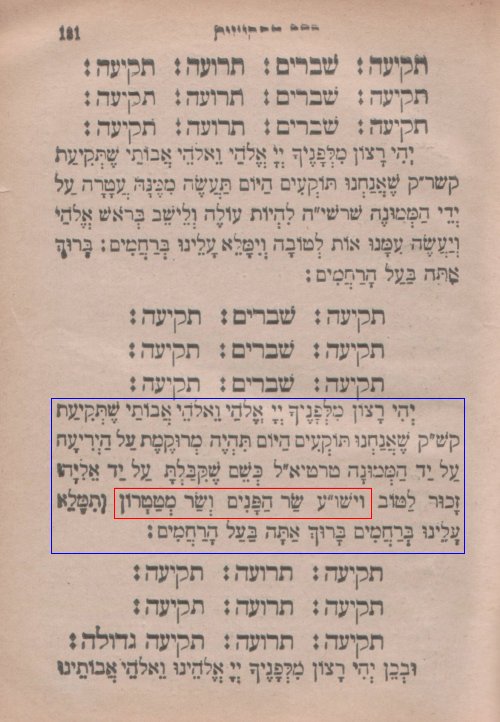
“Yehi razton milefancha shet’kiat tashrat sh’anachnu tokim t’hei m’rukemet hai’reeah al yadei hammunah Tartiel k’shem sheqibalta al yad Eliyahu Z”L, viY’shua Sar HaPanim v’Sar MemTet. V’timeleh aleinu b’rachamim. Baruch atah HaShem, ba’al rachamim.”
10 And he said to me, “Do not seal the words of the prophecy of this book, for the time is at hand.
11 He who is unjust, let him be unjust still; he who is filthy, let him be filthy still; he who is righteous, let him be righteous still; he who is holy, let him be holy still.”
This connects back to the idea of hot and cold in 3:15,16. This is not to say that people cannot turn from their ways. It is more reflective of a final judgment that is beyond that point.
The Ramchal, in “Derech Hashem” states:
G-d’s goodness decreed that there be a limit to [the time period of] man’s effort required to attain perfection. After this period is completed, he attains his level of perfection, and is then able to enjoy it for all of eternity. G-d therefore created two distinct periods, one as a time of earning, and the other as a time of receiving benefit. (1:3:3).
Since the aspect of good is greater, the period of earning is limited, and lasts no longer than G-d’s wisdom decreed suitable for His purpose. The period of reward, however, has no limit, and man continues to derive pleasure from his earned perfection for all of eternity. (1:3:3).
G-d, therefore, created two worlds, Olam Ha’zeh (this world) and Olam Haba (the world to come). (1:3:4).
The purpose of the creation is that man should merit to attain the true good. The end point of this process is a connection to G-d and tranquility in Olam Haba. However, the Highest Wisdom decreed that it would be most fitting and appropriate for man to first exist in Olam Ha’zeh as the ideal preparation to reach this desired purpose. (2:2:1).
The ultimate and main place of benefit for good deeds is in Olam Haba, as we have said. The s’char (benefit) for the one who merits it is an eternal bonding with Hashem, and the onesh (negative consequence) is being pushed away from this true good and being lost. (2:2:3).
12 “And behold, I am coming quickly, and My reward is with Me, to give to every one according to his work.
The Rambam wrote:
Perhaps this good will seem trivial in our eyes. There is no way in Olam Ha’zeh to be able to appreciate and to understand the great benefit that there will be for the nefesh in Olam Haba — because while we are in Olam Ha’zeh, we can understand only the good of the body, which is what we desire. That exceedingly great [spiritual] good [of Olam Haba] cannot be compared to the good of Olam Ha’zeh, except by way of analogy. There is no way to really compare the benefits for the nefesh in Olam Haba with what is good for the body in Olam Ha’zeh, such as food and drink. Rather that great good [in Olam Haba], which cannot really be understood, is beyond any value or comparison. (Hilchot Teshuva 8:6).
That enjoyment is indivisible and indescribable. It cannot even be intimated by means of an allegory. It can only be hinted at, as the prophet has done. When he realized the greatness of this absolute good and its high level, King David declared (Tehillim 31, 20): “And how great is Your bounty that You have hidden for those who fear You!” And they explain that the “enjoyment of the Divine Presence” means that these souls are elated by what they grasp and know of the true nature of G-d, the same as the holy Chayot and the other classes of Angels are elated by their understanding and knowledge of His Essence. The final good and purpose, therefore, is to reach and join this exalted group at that high level… This is the great good to which no other good can be compared. No pleasure can equal it, for how can that which is eternal be compared to something transitory? (Perek Chelek).
Rabbi Eliyahu Eliezer Dessler (1892-1953) says:
Who could possibly understand or imagine with their intelligence the incredible treasure they will merit [in Olam Haba]? Every degree of victory over the yeitzer hara for the sake of Heaven will lead to an independent aspect of the revelation of the reality of Hashem. Fortunate will be the one who merits this. How much will the days of his life be filled with spiritual elevation from Torah andmitzvot in this world, and how much will he grow through this elevated life in Olam Haba! How wondrous are these things for the one who understands what their greatness will be in Olam Haba. (Michtav M’Eliyahu 287–2 88).
The Medrash says that Rebbe Abahu was shown his future s’char before his death — thirteen rivers of pure afarsimon, a hint to the wonders of how Hashem relates to us with the thirteenmiddot of rachamim (aspects of mercy). He asked — “Who is all of this for?” and was told — “For you.” He was amazed, and exclaimed — “All of this for Abahu? I thought that my toil had been for nothing, and my strength had been spent for emptiness. However, Hashem is just.” (Bereshit Rabba 62b, Shemot Rabba 52:3) The tzadikim, in their humility, will be amazed and startled by the s’char that will be given to them. (Michtav M’Eliyahu — Hispatchus S’char — 5:383).
Rav Dessler wrote:
Whatever we are able to experience and grasp in Olam Haba will continue to grow and increase. This is the concept of the tzadik continuing to climb higher in Olam Haba. He won’t only grow in his understanding to the next higher level, but this experience will also grow from level to level, forever and ever… This treasure will allow us to ascend higher and higher without end, forever and ever. And who is capable of picturing the incredible pleasure which will never stop growing and will become sharper and clearer forever?… Every bit of our Torah and mitzvot, every aspect of our fight against the yeitzer hara (negative inclination) which allowed us to grow in this world, is a separate root which will flourish continually in Olam Haba. With every aspect we will see the greatness of G-d’s kindness and recognize His goodness, and this will continue forever and ever. We will come to Olam Haba with all of these roots together, and continually be elevated from them, separately as well as together.
An angel is called an omeid — one that is standing still. Since it has no avodah (active service) and s’char, it cannot have any development. Therefore, it always remains in its place. But thetzaddik — since he had constant development in Olam Ha’zeh in his avodah, he has constant development in his s’char in Olam Haba as well. (Michtav M’Eliyahu 287–288, 5:383).
13 I am the Alpha and the Omega, the Beginning and the End, the First and the Last.”
ENTER CONCEPTS ASSOCIATED WITH SHIR HASHIRIM HERE – MASHOACH BEING FIRST AND LAST (Cite matthew first will be last and the alef-tav found in scrupture)
Tie in more on Rachel and Jacob and Leah
“Concerning the domain of holiness, too, it is written, “I am first and I am last.” In this verse, “I am first” refers to the aspect of G-dliness, which encompasses and transcends all worlds, and which is known as “sovev kol almin.” “I am last” refers to the aspect of G-dliness which is immanent in all worlds, and which is known as “mamaleh kol almin.” Though sovev kol almin is distinct from memaleh kol almin, it is its source and root.
An End to Evil: Reishes Goyim Amalek, Rabbi Yosef Yitzchak Schneeersohn
In addition, two recommended books on these subjects are Through a Speculum that Shines and Along the Path by Elliot Wolfson. We will cite from these texts in this section.
Wolfson explains the above concepts as follows:
The paradox that the deus absconditus (hidden God) appears to human beings in multiple forms, including, most significantly, that of an anthropos (man) is the enduring legacy of the prophetic tradition that has informed and challenged Judaism throughout the ages … The prophetic tradition, epitomized in Hosea 12:11, that God can be represented in images served as an exegetical basis for certain mythic ideas that evolved in the aggadah from the formative period of rabbinic Judaism The most significant of these is that God assumed “incarnational forms” at critical moments in Israel’s sacred history: at the splitting of the Red Sea he is said to have appeared as a young warrior and at Sinai as a merciful elder; he is sometimes further described as a scribe teaching Torah. 1Representing God anthropomorphically in auditory imagery is not theologically offensive, for that mode of representation does not violate the basic principle of God’s irreducible otherness. Indeed, it is alone the speech of God that bridges the gap separating humanity and the divine. Thus one finds a verbal/auditory emphasis affirmed in many prophetic revelations that conform to the Deuteronomic restriction on iconic representation yet preserved the lived immediacy of biblical religion … Anthropomorphic expression can be appropriated as a meaningful mode of discourse if it is circumscribed within a linguistic field.
Through a Speculum That Shines: Vision and Imagination in Medieval Jewish Mysticism, Elliot R. Wolfson, Princeton University Press, Princeton, NJ, 1994, p.15
Specifically regarding angels in prophetic vision he cites …
It is customary for God to clothe the thoughts of His decrees, to show them to the prophets so that they will know that God has set His decrees. The prophet knows His thoughts according to the vision that he sees. At times this vision is called an angel.
Through a Speculum That Shines: Vision and Imagination in Medieval Jewish Mysticism, Elliot R. Wolfson, Princeton University Press, Princeton, NJ, 1994, p.206, citation from Sefer ha-Shem, Rabbi Eleazer ben Judah of Worms
Though this verse would appear to be associated with Yeshua, the divergent characteristics of “beginning and end” and “first and last” are (not surprisingly) found regarding Metatron.
Citing the 13th century kabbalist Abraham Abulafia, author Wolfson shows that these opposite characteristics (beginning and end, etc.), are found in Metatron and resemble the combination of Israel and Jacob, found in a single person:
In the ontological scheme of Abulafia,, based on Maimonides, Metatron is the Active Intellect or the last of the ten separate intellects. On the other hand, Metatron is also described as the first of the created entities outside the divine. Abulafia alludes to this dual status of Metatron in his comment that the angel of God “is the end of the angels, but he is still the beginning.” The two aspects of Metatron are alluded to as well in the names Israel and Jacob.; the secret of the former is conveyed in the transposition of the consonants “yisra’el” to form the word “le-ro’shi” (to my head), and the latter in he letters ya’aqov that are transposed into “aqevi (my heel). The aspect of Metatron as the first is conveyed in the physical image of the head, and as the last, in the image of the heel … Just as Israel and Jacob are two names for one and the same person, so too the two aspects are unified in the one angelic personality. Metatron is described therefore, as possessing opposite qualities, the first and the last, beginning and end …
Along the Path: Studies in Kabbalistic Myth, Symbolism, and Hermeneutics, Elliot R. Wolfson, State University of New York Press, Albany, 1995, p. 21
14 Blessed are those who do His commandments, that they may have the right to the tree of life, and may enter through the gates into the city.
FIND ZOHAR ON TORAH = CENTRAL PATH
As mentioned previously, the denial of access to the Tree of Life is fundamentally related to the sin of separating the bride from the groom. This may also be expressed in terms of division between YHVH and Adonai. (See our Study Chart on the Name of God.) Thus the tikkun of the the bride/groom (or YHVH/Adonai) and access to the Tree of Life, is directly tied to the keeping of the commandments of the Torah. (See comments on uniting the bride and groom in notes to 19:10.)
As mentioned earlier in this study …
Furthermore, one of the special paragraphs said in advance of a mitzvah, to focus us on the purpose of the mitzvah (found in most prayer books) is: [I hereby do this mitzvah] for the sake of the unification of The Holy One, Blessed is He, and His Divine Presence, in fear and in love, to unify the Name of yud-h’eh with vav h’eh in completion, in the name of the entire Jewish people.
From http://www.torah.org/learning/perceptions/5760/vaeschanan.html – Parshas Vaeschanan/Nachamu, Pleading in Comfort, by Rabbi Pinchas Winston.
The Zohar offers the following regarding keeping of the commandments. Note yet another dichotomous reference to Metatron from whom come both life and death:
Soncino Zohar, Bereshith, 27a – AND THE LORD GOD TOOK THE MAN AND PUT HIM IN THE GARDEN OF EDEN, ETC. From whence did he take him? He took him from the four elements which are hinted at in the verse “and from there it parted and became four heads”. God detached him from these and placed him in the Garden of Eden. So does God do now to any man created from the four elements when he repents of his sins and occupies himself with the Torah; God takes him from his original elements, as it is said, “and from there he parts”, i.e. he separates himself from the desires which they inspire, and God places him in his garden, which is the Shekinah, “to dress it”, by means of positive precepts, “and to keep it”, by means of negative precepts. If he keeps the law, he makes himself master of the four elements, and becomes a river from which they are watered, and they obey him and he is their ruler. But if he transgresses the law, they are watered from the bitterness of the tree of evil, which is the evil inclination, and all his limbs are full of bitterness; but when the members of the body are kept holy from the side of good, it may be said of them that “they came to Marah and were not able to drink waters from Marah, for they were bitter” (Ex. XV, 23). Similarly, the study of the Talmud is bitter compared with that of the esoteric wisdom, of which it is said, “And God showed him a tree” (Ibid.); this is a tree of life, and through it “the waters were sweetened”. Similarly of Moses it is written, “And the staff of God was in his hand.” This rod is Metatron, from one side of whom comes life and from the other death. When the rod remains a rod, it is a help from the side of good, and when it is turned into a serpent it is hostile, so that “Moses fled from it”, and God delivered it into his hand. This rod typifies the Oral Law which prescribes what is permitted and what is forbidden. When Moses struck the rock God took it back from him, and “he went down to him with a rod” (II Sam. XXXIII, 21), to smite him with it, the “rod” being the evil inclination, which is a serpent, the cause of the captivity. A further lesson can be derived from the words “and from there it parted”: happy is the man who devotes himself to the Torah, for when God takes him from this body, from the four elements, he is detached from them and ascends to become the head of the four Hayyoth, as it is written, “and they shall bear thee on their hands” (Ps. XCI, 12).
15 But outside are dogs and sorcerers and sexually immoral and murderers and idolaters, and whoever loves and practices a lie.
AMALEK – DOG – CALEB? DOES NOT ENTER SPIES ETC
The Rambam (Hilchot Teshuva 8:1) wrote:
The good which is hidden for the tzadikim (righteous) is chayei Olam Haba — life in the world to come. This is the life which has no death associated with it, and the good which has no bad associated with it… The s’char (benefit) for the tzadikim is that they should merit this pleasure and this good, and the negative consequence for the wicked is that they will not merit this life, but rather be cut off and die.
16 “I, Yeshua, have sent My angel to testify to you these things in the congregations. I am the Root and the Offspring of David, the Bright and Morning Star.”
Could angel be messenger here and refer to John?
Here we have Yeshua referring to “his angel.” The idea of a specific angel being associated with messiah ben Joseph is found in several sections of the text, Kol Hator (Voice of the Turtledove):
Yosef is still alive. — The independence of Mashiach ben Yosef is related to three categories:
a) the Mashiach ben Yosef from above is Metatron, the Minister of Interior; as is known, Yosef is Metatron. Both of them are from the light from above, and both are in the sefira Yesod ,,,
b) In every generation one Mashiach ben Yosef from below appears. He is a righteous person, a foundation of the world, who because of his deeds and the root of his soul, merits acting for the salvation of Israel, carrying out helpful deeds and glorifying the Torah through his dedication. Thus he reaches to the high level of Mashiach ben Yosef …
c) Mashiach ben Yosef who is present in every house of Israel in general, according to what is revealed by the words “remnant of Yosef” which was said about all of Israel in general and regarding every man of Israel in particular … “For a bird of the skies will carry the sound, and some winged creature will relate the matter” — This was said about Metatron, the Minister of Interior, as brought in Tikunei Zohar. He is the Angel of Mashiach ben Yosef. “The angel who redeems me” — “The angel who redeems” is the Angel of Yosef. This means that as soon as Yosef was born, Jacob was able to overpower Esau. As known, the redeemer is in Yesod.
17 And the Spirit and the bride say, “Come!” And let him who hears say, “Come!” And let him who thirsts come. Whoever desires, let him take the water of life freely.
Ruach and Shekinah
18 For I testify to everyone who hears the words of the prophecy of this book: If anyone adds to these things, God will add to him the plagues that are written in this book;
19 and if anyone takes away from the words of the book of this prophecy, God shall take away his part from the Book of Life, from the holy city, and from the things which are written in this book.
Punishment of kareth
The warning is strict, as the sages teach that even the slightest actions of one person can cause a “ripple effect” with profound negative results for many:
Do not be surprised by the fact that an individual person, through his or her deeds, can cause an elevation or degradation of the whole world….
See http://www.kabbalaonline.org/Society/nonjews/The_Inner_Aspect_of_the_World.asp
20 He who testifies to these things says, “Surely I am coming quickly.” Amen. Even so, come, Lord Yeshua!
21 The grace of our Lord Yeshua haMashiach be with you all. Amen.
1. Through a Speculum That Shines: Vision and Imagination in Medieval Jewish Mysticism, Elliot R. Wolfson, Princeton University Press, Princeton, NJ, 1994, p.8
2. ibid, p.15
3. ibid, p.206, citation from Sefer ha-Shem, Rabbi Eleazer ben Judah of Worms
4. ibid, p.255
17.
18
19. See http://www.yedidnefesh.com/kaballah/kol-hator/1.htm
20.
21.
22.
We highly recommend you continue study with our Song of Songs Project over at Matrix4Humans.com/song-of-songs